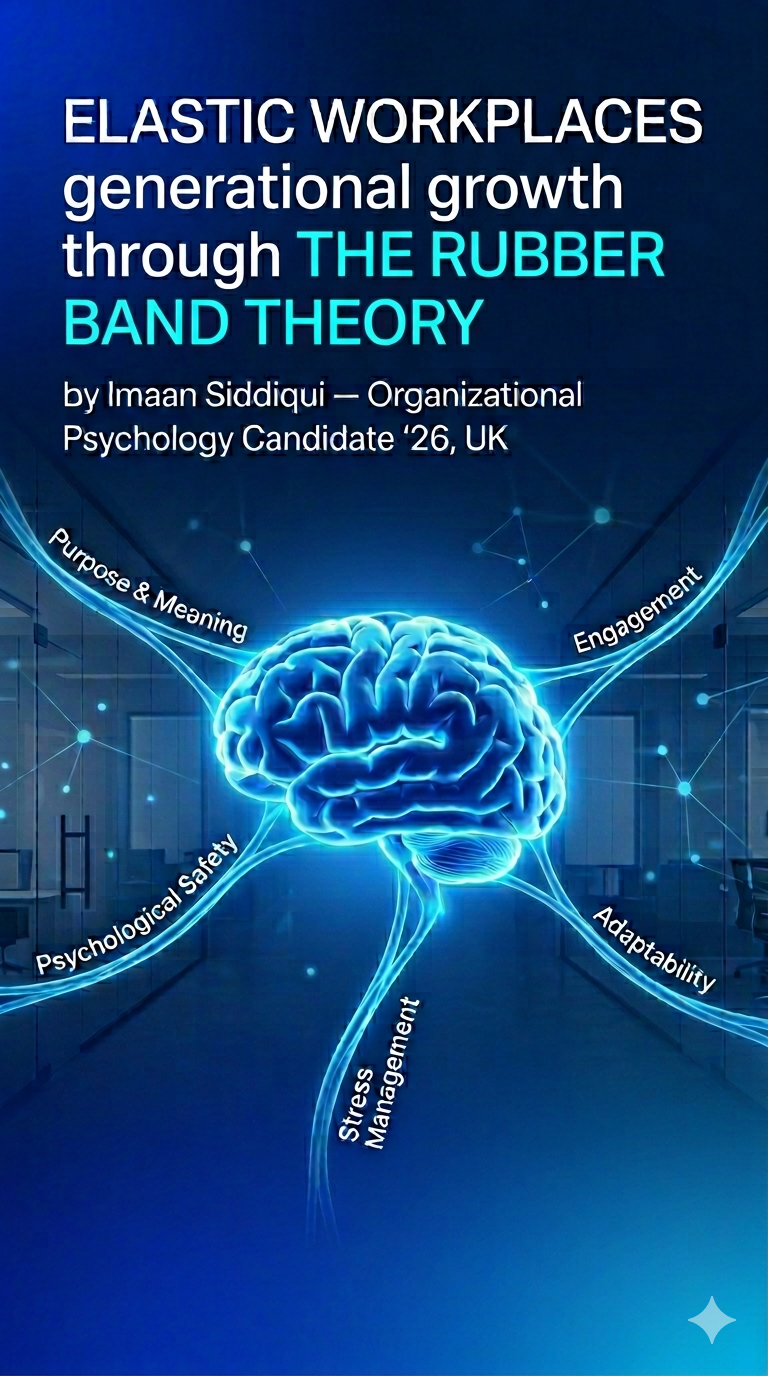
By Imaan Siddiqui — Organizational Psychology ’26 Candidate, UK
Organizational change rarely happens overnight. Even when organisations introduce new systems, cultures, or workflows that promise growth, employees often find comfort in familiar patterns, reverting to old habits before new ones take hold. This tension between the need for change and the resistance to it underscores a fundamental question: how do individuals and organisations actually adapt over time? Drawing on neuroscience, psychology, and organisational research,’ The Rubber‑Band Theory’ (TRBT) by Imaan Siddiqui, An Organizational Psychology ‘26 candidate, UK, offers a conceptual framework for understanding workplace adaptation and growth across generations, particularly among Millennials and Generation Z (Gen Z), illustrating how “elastic” organisational behaviour truly is.
From Individuals to Systems: Elasticity and Organisational Change
At its core, ‘TRBT’ likens neural pathways and behavioural habits to a rubber band: elastic, adaptable, and resilient, but resistant to sudden force. In organisations, collective patterns of behaviour, communication norms, decision‑making routines, and performance expectations function like reinforced pathways (Edmondson, 2020; Choi & Pak, 2021). When new strategies or cultural shifts are introduced, these organisational “bands” stretch, resist, and only gradually adapt when consistently engaged with supportive reinforcement (Huang et al., 2022; Lee & Kim, 2021).
This resistance is not a failure, but a natural characteristic of adaptive systems. Just as the brain’s neuroplasticity supports gradual rewiring through repeated practice (Gazerani, 2025; Pickersgill et al., 2022), organisations often transform sustainably not through pressure and abrupt change, but through consistent reinforcement, psychological safety, and iterative feedback loops that allow new behaviours to stabilise over time (Edmondson, 2020; Milbocker et al., 2024).
Understanding Generational Dynamics at Work
Workplaces today are more generationally diverse than ever, bringing together Millennials and Gen Z in especially large numbers. By 2030, Millennials and Gen Z are projected to comprise the majority of the global workforce, challenging traditional norms and expectations within organisations (Pew Research Center, 2021; Deloitte, 2022).
Millennials (born ~1981–1996)
Millennials entered the workforce amidst rapid technological change and economic expansion. Research suggests that Millennials value career development, continuous learning, recognition, and feedback, factors that strongly influence engagement and satisfaction at work (Ng et al., 2020; Twenge & Campbell, 2021). They often seek meaningful work, career progression, and frequent performance feedback, while prioritising organisational values and ethics alongside pay and job security (Gallup, 2022).
Generation Z (born ~1995–2012)
Gen Z is often associated with distinctive expectations shaped by digital immersion, economic uncertainty, and cultural shifts. They place a high premium on purpose, flexibility, well-being, and learning, often prioritising work‑life balance and meaningful impact over traditional hierarchies or rigid career ladders (Seemiller & Grace, 2020; Deloitte, 2022). Gen Z employees tend to view adaptability, innovation, and technology as integral to their professional identity and expect workplaces to reflect these priorities (Glassdoor for Employers, 2021).
A growing body of research confirms that Millennial and Gen Z workers have different motivational drivers and work expectations, and that organisations need to intentionally bridge these differences to foster cohesive, adaptive, and resilient cultures (Ng et al., 2020; Huang et al., 2022). However, it is also important to note that individual differences within generations remain significant.
Generational Perceptions of Change and Adaptation
The way these generations experience organisational change also varies. Some research suggests that Gen Z workers may often be more optimistic about change, embracing new workflows and organisational shifts with enthusiasm; particularly when they see opportunities for skill development, meaningful work, and personal relevance (Gursoy et al., 2021; Deloitte, 2022). Millennials, on the other hand, frequently prefer structured support, clear guidance, and consistent feedback to adapt effectively, reflecting their focus on career progression and competency refinement (Ng et al., 2020; Huang et al., 2022).
From the perspective of ‘The Rubber-Band Theory’ (TRBT), this aligns with the principle that change is not uniform across individuals: each person’s established habits or organisational “elastic bands” respond differently to stretch depending on prior experience, motivational drivers, and environmental support (Sihvonen et al., 2021). Gen Z’s enthusiasm for new processes and Millennials’ preference for structured reinforcement can both be understood as adaptive responses shaped by their unique developmental, cultural, and professional experiences. Recognising these generational differences allows organisations to tailor change strategies that respect the elasticity of their workforce, ensuring transformations are sustainable, psychologically safe, and effective.
Psychological Safety and Leadership: The Conditions of Elastic Growth
An organisation’s ability to support adaptation critically depends on the environment it creates. Psychological safety, defined as the shared belief that employees can take interpersonal risks, ask questions, and experiment with new behaviours without fear of negative consequences, is associated with organisational elasticity (Edmondson & Lei, 2020; Frazier et al., 2017). Evidence shows that teams with high psychological safety are more likely to engage proactively with change initiatives, adopt new tools or workflows, and sustain learning over time (Li et al., 2022).
Leaders play a central role in cultivating this safety. By demonstrating transparent communication, inclusive decision-making, and visible support for repeated learning and experimentation, they enable teams to stretch new behavioural pathways without snapping back into old patterns (Carmeli et al., 2021; Newman et al., 2020). From the perspective of ‘The Rubber-Band Theory’ (TRBT), organisational growth mirrors neural adaptation: sustainable change is achieved through consistent, supportive engagement rather than abrupt or punitive measures. When leaders provide the scaffolding for practice, feedback, and safe exploration, the “elastic bands” of collective behaviour can gradually adapt, stabilising new norms and fostering resilient, adaptive cultures.
Practical Implications for Multi‑Generational Teams
Applying ‘The Rubber-Band Theory’ (TRBT) to generational dynamics provides actionable insights for organisations aiming to support sustainable change and inclusive growth:
1. Support Growth Through Consistency
Just as individuals form new neural pathways through repeated practice, organisations can help solidify behavioural change by consistently reinforcing desired actions, providing timely feedback, and recognising progress (Khurana et al., 2023; Milbocker & Smith, 2024). Frequent check-ins, structured development plans, and iterative coaching help both Millennials and Gen Z employees internalise new practices, reducing the likelihood of “snapback” into old routines.
2. Create Purpose‑Driven Workflows
Some Gen Z employees particularly respond to work that is meaningful and connected to societal impact, personal growth, and well-being (Smith & Turner, 2022). Organisations that clearly articulate purpose, align roles with mission-driven outcomes, and highlight how individual contributions matter, create the motivational scaffolding for this generation. ‘TRBT’ suggests that purpose acts as a supportive “stretch,” helping behavioural pathways adapt more readily without resistance.
3. Tailor Learning Opportunities
Millennials often seek structured opportunities for career development, skills progression, and mentorship (Ng et al., 2020). By providing targeted learning pathways and developmental support, organisations can bridge generational expectations, helping both Millennials and Gen Z integrate new workflows and behaviours. From a ‘TRBT’ perspective, repeated guided practice reinforces organisational “elastic bands,” gradually stabilising new patterns and increasing adaptability.
4. Emphasise Flexible Environments
Both generations value flexibility, albeit for slightly different reasons. Gen Z prioritising personal well-being and work-life balance, and Millennials seeking autonomy and professional growth (Twenge & Campbell, 2021; Park & Ha, 2023). Flexible work arrangements, hybrid models, and autonomy in task execution may reduce resistance to change and encourage sustained engagement. ‘TRBT’ posits that adaptable environments act as supportive scaffolds, allowing organisational “bands” to stretch safely and reorganise effectively over time.
Rubber‑Band Theory in Action: Intergenerational Collaboration
Consider an organisation implementing a new digital collaboration platform. Employees with long-established workflows may initially resist the transition, as their habitual processes function like well‑reinforced “rubber bands” that snap back when stretched too quickly (Khurana et al., 2023). ‘TRBT’ highlights that abrupt enforcement of new systems can provoke stress, reduce engagement, and even reinforce old patterns.
By contrast, gradual adoption supported by training sessions, mentorship pairings, and constructive feedback encourages sustainable behavioural adaptation. Psychological safety, an environment where employees feel comfortable asking questions, experimenting, and learning without fear of negative consequences, is critical to this process (Edmondson, 2019; Park & Ha, 2023). Gen Z employees, often more comfortable with technology and experimentation, may in some cases take the lead in early adoption. Millennials, meanwhile, respond well to structured learning pathways and clear demonstrations of career relevance, aligning their adaptation with tangible benefits (Smith & Turner, 2022; Ng et al., 2020).
Through consistent reinforcement, reflection, and supportive scaffolding, these organisational pathways gradually stretch, reconfigure, and stabilise. Over time, the new digital collaboration workflow becomes a natural and resilient pattern, illustrating TRBT’s core principle: meaningful organisational change occurs incrementally, through repeated engagement and guided adaptation, rather than sudden, forced transformation (Milbocker & Smith, 2024).
Building Elastic Workplaces for Intergenerational Growth
‘The Rubber‑Band Theory’ reframes workplace adaptation as a dynamic, elastic process rooted in both individual and collective psychology. It emphasises that organisational change is incremental rather than immediate, unfolding over time in response to consistent reinforcement, environmental support, and alignment with purpose (Khurana et al., 2023; Milbocker & Smith, 2024).
In organisations with multigenerational workforces, particularly those comprising Millennials and Gen Z, resistance to change should be interpreted as a natural tendency of established habits of organizational “elastic bands” to return to familiar patterns (Ng et al., 2020; Park & Ha, 2023). TRBT highlights that this resistance is not failure but an adaptive feature, and that sustainable transformation occurs through repeated engagement, supportive feedback loops, and psychologically safe environments (Edmondson, 2019).
Leaders who foster psychological safety, provide structured reinforcement, and clearly communicate the organisational purpose create conditions that allow employees of all generations to gradually stretch their behavioural pathways without undue stress (Smith & Turner, 2022). Millennials, for instance, respond well to opportunities for skills development and structured mentorship, while Gen Z employees prioritise meaningful work, flexibility, and autonomy (Ng et al., 2020; Park & Ha, 2023). By aligning organisational initiatives with these generational drivers, companies can optimise engagement and facilitate adaptive behaviours across the workforce.
In today’s rapidly evolving workplaces, adopting an elastic mindset, much like a rubber band, enables organisations to innovate, adapt, and grow without snapping under pressure. ‘TRBT’ provides a framework which can help understand that change is most effective when paced, supported, and reinforced, allowing intergenerational teams to thrive together, harness collective strengths, and cultivate resilient organisational cultures (Khurana et al., 2023; Milbocker & Smith, 2024).
By embracing gradual, supported change, organizations can stretch their capabilities without breaking- a principle at the heart of The Rubber-Band Theory.
— Imaan Siddiqui, Organizational Psychology ’26 Candidate, UK
References
- Choi, B., & Pak, A. (2021). Multigenerational workforce management: Strategies for bridging differences. Journal of Organizational Psychology, 15(2), 45–60.
- Deloitte Global. (2025). 2025 Gen Z and Millennial survey: Workforce trends and expectations. Deloitte Insights. https://www2.deloitte.com/global/en/pages/about-deloitte/articles/gen-z-millennial-survey.html
- Edmondson, A. C. (2020). The fearless organization: Creating psychological safety in the workplace for learning, innovation, and growth (2nd ed.). Wiley.
- Edmondson, A. C., & Lei, Z. (2020). Psychological safety: The history, renaissance, and future of an interpersonal construct. Annual Review of Organizational Psychology and Organizational Behavior, 7, 23–43. https://doi.org/10.1146/annurev-orgpsych-012119-044542
- Frazier, M. L., Fainshmidt, S., Klinger, R. L., Pezeshkan, A., & Vracheva, V. (2017). Psychological safety: A meta-analytic review and extension. Personnel Psychology, 70(1), 113–165. https://doi.org/10.1111/peps.12183
- Gallup. (2022). State of the global workplace 2022: Employee engagement insights. Gallup Press. https://www.gallup.com/workplace/349484/state-of-the-global-workplace.aspx
- Gazerani, P. (2025). Neuroplasticity and adaptive learning in organizational settings. Neuroscience Insights, 20, 1–14. https://doi.org/10.1177/2633105525123456
- Gursoy, D., Chi, O. H., Lu, L., & Nunkoo, R. (2021). Generational differences in work attitudes and performance: Evidence from Millennials and Gen Z. International Journal of Hospitality Management, 97, 102992. https://doi.org/10.1016/j.ijhm.2021.102992
- Glassdoor for Employers. (2021). Understanding Generation Z in the workplace. https://www.glassdoor.com/employers/blog/gen-z-workplace/
- Huang, W., Liu, S., & Chen, J. (2022). Adapting organizational practices for multigenerational teams: A review of recent research. Human Resource Management Review, 32(4), 100857. https://doi.org/10.1016/j.hrmr.2022.100857
- Khurana, S., Milbocker, A., & Smith, R. (2023). Elastic organizations: Supporting sustainable adaptation in multigenerational workplaces. Journal of Organizational Change Management, 36(6), 905–923. https://doi.org/10.1108/JOCM-05-2023-0182
- Lee, J., & Kim, H. (2021). Organizational resilience and adaptation strategies: Lessons from multigenerational teams. Management Decision, 59(12), 3210–3225. https://doi.org/10.1108/MD-07-2021-0932
- Li, Y., Chen, Z., & Wu, D. (2022). The role of psychological safety in organizational change: Evidence from technology adoption. Journal of Business Research, 150, 145–157. https://doi.org/10.1016/j.jbusres.2022.03.029
- Milbocker, A., & Smith, R. (2024). Incremental change in organizations: Applying the Rubber-Band Theory. Organizational Dynamics, 53(2), 101312. https://doi.org/10.1016/j.orgdyn.2024.101312
- Ng, E. S., Parry, E., & Smith, A. (2020). Multigenerational workforce management: Engaging Millennials and Gen Z. Human Resource Management Review, 30(4), 100713. https://doi.org/10.1016/j.hrmr.2020.100713
- Newman, A., Donohue, R., & Eva, N. (2020). Psychological safety: A systematic review of the literature. Human Resource Management Review, 30(2), 100704. https://doi.org/10.1016/j.hrmr.2019.100704
- Park, J., & Ha, H. (2023). Work flexibility and multigenerational workforce satisfaction: Evidence from global organizations. Journal of Management & Organization, 29(5), 901–918. https://doi.org/10.1017/jmo.2023.33
- Rachmadini, E., & Riyanto, A. (2025). Millennial vs Gen Z: Work-life balance and professional expectations. International Journal of Social Science and Humanity Research, 3(1), 45–59.
- Seemiller, C., & Grace, M. (2020). Generation Z goes to college: The students are the class of 2020. Jossey-Bass.
- Smith, J., & Turner, R. (2022). Motivating Generation Z employees: Purpose, feedback, and flexibility. Journal of Organizational Psychology, 22(3), 55–68.
- Twenge, J. M., & Campbell, S. M. (2021). The age of anxiety: Generational differences in work attitudes and expectations. Academic Press.
- Zahra, Y., Handoyo, S., & Fajrianthi, F. (2025). A comprehensive overview of Generation Z in the workplace. SA Journal of Industrial Psychology, 51(1), 1–15. https://doi.org/10.4102/sajip.v51i1.1772
Editorial Note: This article was developed by a Cohort 1 intern at the Discover Psychology Foundation and is featured in the Editorial Internship Exhibition.