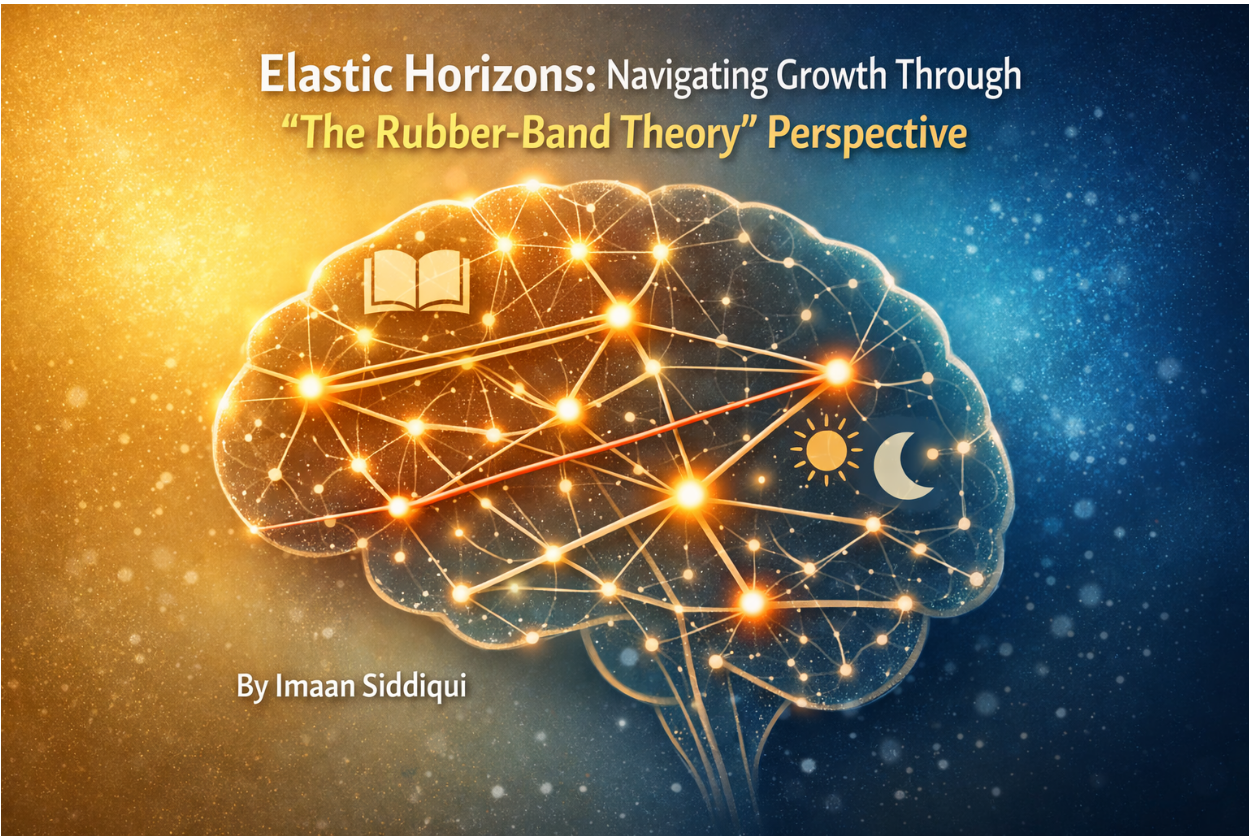
By Imaan Siddiqui — Organizational Psychology ’26 Candidate, UK
Change seldom follows a straight line. Many of us have vowed to adopt a new habit, mindset, or routine, only to find ourselves slipping back into old patterns despite our best intentions. The frustration and self-doubt that accompany such cycles are universal, prompting a deeper question: how does change actually occur in the brain, and what drives or hinders behavioral transformation? Drawing on contemporary neuroscience, psychology, and lived human experience, “The Rubber‑Band Theory” (TRBT) by Imaan Siddiqui offers a way to understand personal growth not as linear progress or an “all‑or‑nothing” transformation, but as a dynamic process of elastic adaptation; one that stretches, resists, reconfigures, and gradually stabilizes over time, allowing for both setbacks and forward movement.
At the heart of this perspective lies neuroplasticity, the brain’s remarkable capacity to reorganize itself in response to experience, learning, and environmental influences. Once thought to be confined to childhood development, modern research now shows that the human brain retains this adaptability throughout life, though with natural constraints and individual variation (Gazerani, 2025). Neuroplasticity does not guarantee effortless or immediate change; rather, it provides the biological potential for transformation when conditions, repetition, and supportive context align, highlighting that personal growth may be an ongoing, carefully nurtured process rather than an instant achievement.
Neuroplasticity: Understanding the Elastic Mind
In simple terms, neuroplasticity refers to the brain’s remarkable ability to modify both its structure and function in response to a wide range of internal and external stimuli, including learning, repeated practice, new experiences, and environmental changes. This process involves synaptic strengthening, structural rewiring, and even the growth of entirely new neural connections, all of which support learning, memory consolidation, skill acquisition, and behavioral adaptation (Gazerani, 2025). In essence, neuroplasticity provides the biological foundation that allows the brain to remain flexible, resilient, and capable of continuous growth throughout life.
Recent research confirms that neuroplasticity persists across the lifespan, enabling meaningful adaptation even in adulthood and later life. While the rate and extent of neural change can vary depending on factors such as age, context, prior experience, and individual physiology, the brain’s capacity to reorganize remains substantial and significant (Gazerani, 2025). This underscores the hopeful reality that personal growth, skill development, and habit formation are biologically supported processes at any stage of life.
However, neuroplasticity is neither inherently positive nor negative; it adapts in the direction of the signals it receives. Repeatedly engaging in a behavior, thought pattern, or habit strengthens the corresponding neural pathways, making these behaviors more automatic over time. Conversely, neglect, chronic stress, or maladaptive patterns can reinforce unhelpful pathways, making change more difficult. This dynamic reflects the central metaphor of ‘The Rubber‑Band Theory’: neural pathways are elastic; they stretch, adjust, and gradually stabilize when gently and consistently engaged, yet resist abrupt, forceful changes, suggesting that lasting transformation is a gradual, patient process rather than a sudden leap.
Why Change Feels Hard: The Mechanics of Elasticity
The Rubber‑Band Theory (TRBT) likens the brain’s neural pathways to an elastic band, illustrating how change naturally involves resistance and gradual adaptation. When new experiences, behaviors, or thought patterns are introduced, these pathways stretch but resist sudden or extreme shifts, creating the familiar tension and difficulty associated with personal growth. Only through consistent, repeated engagement practiced with patience and supportive context; do these pathways may gradually adapt, reorganize, and stabilize, forming new patterns that eventually feel natural, integrated, and sustainable over time.
Classic ideas such as “change takes 21 days” oversimplify the nuanced and highly individualized reality of human adaptation. Empirical research on habit formation demonstrates that the time course for new behaviors to become automatic varies widely across individuals and types of habits, often extending beyond two months depending on complexity and environmental factors (Khurana et al., 2025). This highlights a key insight: lasting change is often not instantaneous. Rather, it is a process of gradual reinforcement, requiring persistence, reflection, and repeated practice within supportive conditions. The mechanics of elasticity remind us that the brain resists abrupt shifts, and that meaningful adaptation is both incremental and context-dependent, mirroring the stretch-and-release dynamics of a rubber band.
Environmental and Lifestyle Support for Plasticity
Another critical layer of nuance comes from lifestyle and environmental science. Neuroplasticity is influenced by more than repetition or intentional practice alone; it is shaped by a combination of biological, social, and environmental factors that either facilitate or hinder adaptive change. Physical exercise, balanced nutrition, and sufficient restorative sleep all interact with brain health, supporting structural and functional neural adaptation. For instance, regular exercise stimulates the release of growth factors and neurotrophins, which enhance synaptic plasticity, improve cognitive resilience, and strengthen the brain’s capacity to form and maintain new connections (Pickersgill et al., 2022).
Equally important is the influence of social and environmental enrichment. Stimulating learning experiences, opportunities for meaningful practice, supportive relationships, and intellectually engaging environments create conditions in which neural pathways may adapt more effectively and robustly. Conversely, chronic stress, social isolation, or environments that lack stimulation can dampen adaptive plasticity, slowing progress and making change more challenging. This aligns with broader evidence that the brain, much like a rubber band, responds to the quality and consistency of its environment: how it is stretched, supported, and guided determines how efficiently it adapts over time (Milbocker et al., 2024). Understanding these factors underscores the importance of holistic approaches to personal growth, where lifestyle, social support, and environmental enrichment work together to optimize the brain’s natural adaptability.
Why Personal Growth Is Neither Instant Nor Linear
In awareness-driven dialogue, it is essential to avoid romanticizing struggle or portraying stress as inherently positive, as such oversimplifications can mislead or even discourage individuals attempting change. ‘TRBT’ does not suggest that discomfort alone guarantees growth; rather, it emphasizes intentional, directional, and mindful engagement with experience over time. Lasting change is more likely to emerge not through brute force, sudden effort, or rigid timelines, but through consistent, purposeful repetition practiced within a supportive and realistic context that acknowledges individual capacity and readiness.
Setbacks, lapses, and temporary regressions are not signs of personal failure, but natural components of the adaptive process. Just as a rubber band recoils if overstretched, attempts at change that lack sufficient structure, preparation, or environmental support can result in fatigue, frustration, or temporary regression. ‘TRBT’ suggests that growth is achievable, yet deliberate and paced, requiring patience, reflection, and iterative effort. By understanding that personal development unfolds gradually rather than instantaneously, individuals can approach change with compassion, reduce self-criticism, and cultivate sustainable progress that honors both challenge and resilience.
Practical Implications for Everyday Life
When we view personal development through the lens of the Rubber‑Band Theory (TRBT), several practical insights emerge that can guide intentional and sustainable growth:
Consistency Over Intensity: Repeated, moderate engagement with new behaviors may support the strengthening of neural pathways more reliably than sporadic or extreme effort. Small, consistent actions can compound over time, gradually reshaping habits and supporting lasting change.
Supportive Environments Matter: Participating in learning communities, maintaining supportive relationships, and immersing oneself in environments that reinforce desired patterns may increase the likelihood of successful adaptation. Social encouragement, mentorship, and opportunities for meaningful practice act as scaffolds, facilitating smoother, more resilient change.
Lifestyle Influences Plasticity: Sleep, balanced nutrition, and regular physical activity are not optional add-ons; they contribute directly to the brain’s biological capacity to adapt, influencing cognitive resilience, emotional regulation, and neural growth (Pickersgill et al., 2022). Prioritizing these factors creates a foundation for more effective and sustained personal development.
Be Kind to Your Brain: Neural adaptation is an ongoing, incremental process. Harsh self-criticism, rigid expectations, or rushed timelines can hinder progress and create unnecessary stress. Practicing patience, self-compassion, and realistic goal-setting allows the brain’s natural elasticity to support growth without overwhelming it.
These principles remind us that change is neither failure nor magic. It is a multi-layered, context-dependent process rooted in biology, experience, and environment; one that honors both challenge and patience. By applying these insights, individuals can approach personal growth strategically, realistically, and with a compassionate understanding of their brain’s natural rhythms and capacities.
A Compassionate View of Change
For individuals navigating personal growth; whether managing anxiety, acquiring new skills, or reshaping habitual patterns of thought; the neuroplastic perspective may offer grounded optimism and practical hope. Change is not a singular event or instant transformation, but an ongoing, cumulative process of adaptation. Each intentional action, repetition, reflection, and mindful practice gradually contributes to reshaping the brain’s pathways over time, inch by inch, much like the way consistent practice on a musical instrument refines skill, precision, and confidence.
Importantly, this process need not be a solitary struggle. Support systems, empathetic communities, mentors, and environments that foster curiosity, encouragement, and safe experimentation serve as essential scaffolds for growth. Engaging with others not only provides motivation and guidance but also enhances neural adaptation through social learning, shared experiences, and exposure to diverse perspectives. By recognizing that personal development is inherently relational as well as biological, individuals can approach change with both patience and self-compassion, understanding that setbacks and incremental progress are natural parts of the journey rather than indicators of failure.
Stretching With Purpose
The Rubber‑Band Theory (TRBT) reframes personal development as a dynamic, elastic process, grounded in the lived reality of the brain’s remarkable adaptability. It offers a conveptual language and framework that honor both the inherent difficulty of change and its very real possibility, emphasizing that growth is not a fixed destination but an ongoing process of subtle, steady adaptation, incremental, evidence-based, and deeply rooted in biological and experiential factors.
By embracing this perspective, we move beyond oversimplified timelines and rigid expectations, cultivating a more compassionate and realistic understanding of personal growth. The mind bends before it strengthens; neural pathways stretch, adjust, and gradually stabilize in response to consistent engagement, supportive environments, and purposeful practice. With patience, contextual awareness, and deliberate repetition, these pathways become the “rope” that guides individuals forward, enabling meaningful transformation over time. ‘TRBT’ highlights that change is neither immediate nor effortless, but achievable when approached thoughtfully, holistically, and with self-compassion; acknowledging both setbacks and progress as integral parts of the journey.
References
Greenough, W. T., Black, J. E., & Wallace, C. S. (1987). Experience and brain development. Child Development, 58(3), 539–559.
Gazerani, P. (2025). The neuroplastic brain: current breakthroughs and emerging frontiers. Brain Research.
Khurana, R., et al. (2025). The neuroscience of habit formation and behavioural change. International Journal of Environmental Sciences.
Milbocker, K. A., & Smith, I. F. (2024). Maintaining a dynamic brain. PMC.
Pickersgill, J. W., Turco, C. V., Ramdeo, K. S., et al. (2022). The combined influences of exercise, diet and sleep on neuroplasticity. Frontiers in Psychology.
Lally, P., van Jaarsveld, C. H., Potts, H. W., & Wardle, J. (2010). How habits are formed: Modelling habit formation in the real world. European Journal of Social Psychology, 40(6), 998–1009.
Vygotsky, L. S. (1978). Mind in society: The development of higher psychological processes. Harvard University Press.
Cacioppo, J. T., & Cacioppo, S. (2014). Social relationships and health: The toxic effects of perceived social isolation. Social and Personality Psychology Compass, 8(2), 58–72.
Editorial Note: This article was developed by a Cohort 1 intern at the Discover Psychology Foundation and is featured in the Editorial Internship Exhibition.