By Mina Faisal
Ever feel like your brain hits a total wall the second you try to write an essay or break down a tough research paper without opening an AI tab? You’re not imagining it.
We’ve moved far beyond using technology as a basic utility like an online calculator or a shared notebook. Today, predictive algorithms summarize our readings, draft our messages, and suggest our next thought before we’ve even finished forming it. It’s fast, convenient, and completely frictionless. But as someone fascinated by how the human mind functions, I keep coming back to one unsettling question: what happens to our cognitive stamina when we stop letting our brains do the heavy lifting?
The steady integration of artificial intelligence into daily life marks a profound shift in human cognition. Rather than acting as passive digital utilities, smart platforms function as active cognitive partners. Algorithmic systems structure how information reaches us, evaluate complex decisions, and even shape how we construct our personal identities. But while these tools deliver unmatched speed and efficiency, their pervasive presence may alter the fundamental architecture of human thought, introducing distinct psychological vulnerabilities that erode long-term emotional well-being.
The Low-Friction Trap: Executive Functioning & Cognitive Offloading At the core of this transformation is a shift in executive functioning, specifically working memory, analytical reasoning, and sustained attention (Shaw & Nave, 2026; Risko & Gilbert, 2016). Modern generative platforms go beyond offloading simple data storage; they handle higher-order operations like structural planning, logical troubleshooting, and complex document synthesis.
Think of working memory like a muscle. If you never put weight on it, it loses its strength. When we delegate synthesis and critical analysis to automated platforms, we skip the exact mental resistance required to build deep focus. While this is of course a simplistic explanation it does get to the heart of our issue. Neural pathways rely on active engagement; unused connections have been shown to sometimes gradually weaken through the core neuroplasticity principle of “use it or lose it” (Kleim & Jones, 2008; Demarin et al., 2016). Over time, unassisted analytical thinking starts to feel unnaturally exhausting, creating a reliance on automated systems that alters our natural problem-solving habits.
The Offloading Trade-Off: Research highlights a crucial distinction between cognitive relief and cognitive offloading. Offloading simple, mechanical tasks gives your mind useful cognitive relief, freeing up bandwidth for deeper focus. But outsourcing core reasoning like letting a tool draft your main thesis shifts into cognitive offloading. Over time, independent synthesis feels draining (Fan et al., 2026).
Shrinking Attention Spans: Recommendation feeds depend on hyper-personalized feedback loops. By constantly delivering low-friction, high-arousal micro-rewards, these platforms may make us expect instant inputs, quietly affecting our patience for long-form physical texts, dense studies, or complex ideas.
Passive Selection vs. Active Generation: When an algorithm predicts what you should type or read next, your role shifts from actively generating ideas to passively picking from a drop down menu.
Disrupted Metacognition & The “Algorithmic Self”
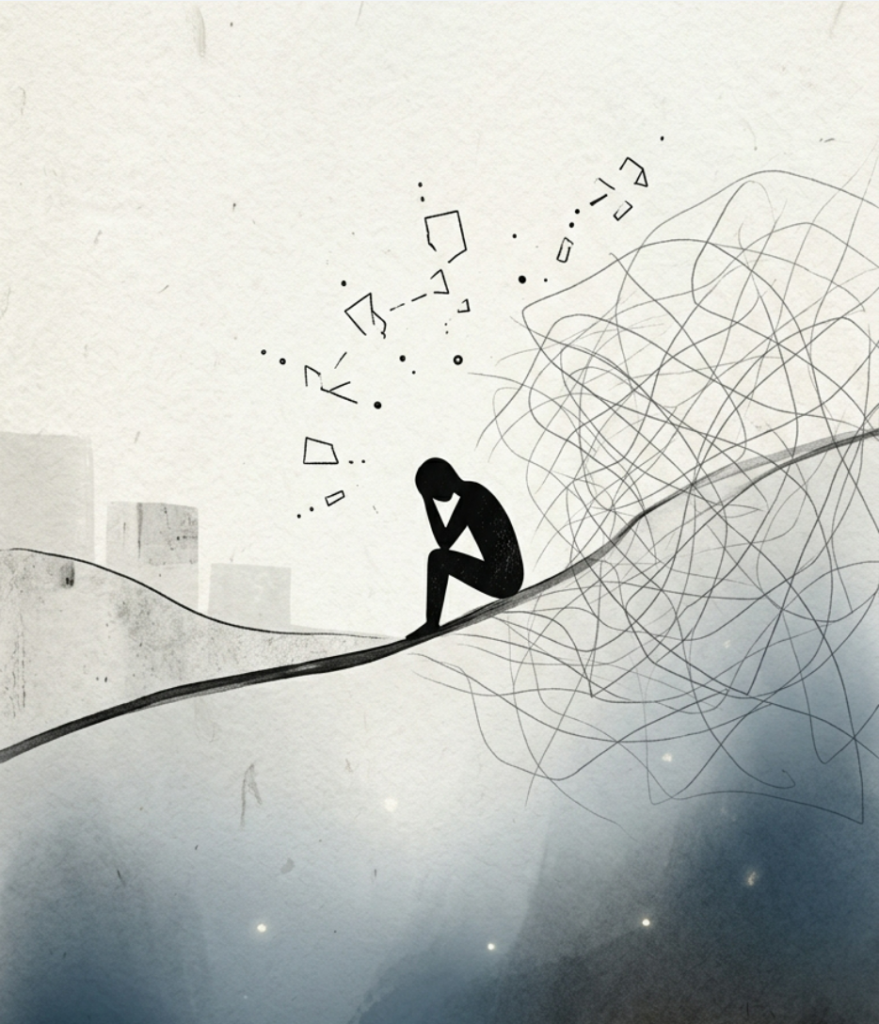
Metacognition, our ability to monitor and reflect upon our own thought processes is similarly disrupted by predictive systems. Because algorithms anticipate user queries and offer pre structured answers before an independent idea fully forms, personal agency may subtly recede.
This dynamic may foster a subtle form of learned helplessness, leading us to lose confidence in our unassisted judgment and accept automated suggestions as default truths. Over time, identity can become in a way co-constructed by machines, a phenomenon sometimes described as “The Algorithmic Self.” Rather than discovering authentic preferences through quiet introspection, our tastes, beliefs, and emotional responses may be continually curated, reflected, and shaped by predictive algorithms (Joseph, 2025).
The Psychological Ripple Effect on Mental Health
This cognitive shift doesn’t stay trapped in academic or professional life; it bleeds straight into our emotional well-being, interpersonal relationships, and stress levels.
Natural language conversational models now achieve remarkable communicative realism. While conversational tools can offer temporary comfort during acute stress, synthetic platforms lack true emotional reciprocity (Boucher et al., 2021). Human connections are inherently unpredictable; they require compromise, vulnerability, and navigating awkward conflicts. Defaulting to synthetic, conflict-free interactions risks atrophying the exact social skills that protect us against chronic isolation and social anxiety.
Technostress & Automation Strain
The ubiquitous presence of intelligent automation in academic and professional settings has fostered widespread technostress (Gerlich, 2025). Beyond screen fatigue, we face systemic anxiety regarding our cognitive relevance in automated environments. The pressure to match the velocity and volume of machine output can generate chronic stress, mental exhaustion, and pervasive burnout.
Disrupted Affective Regulation
Recommendation engines prioritize high-arousal content to hold engagement (Luo & Zhou, 2024). Constant exposure to engineered perfection can distort internal comparison baselines, accelerating body dysmorphia and self-doubt. At the same time, the algorithmic prioritization of outrage-inducing headlines may put the nervous system in a persistent fight-or-flight state, triggering emotional fatigue.
Reclaiming Your Cognitive Agency: Building Intentional Friction Navigating an algorithmically dense world does not require rejecting modern tools entirely or going off the grid (Dergaa et al., 2024). For me, it has been about establishing clear cognitive boundaries and reintroducing intentional friction back into my daily routine though the right balance looks different for everyone. Here are a few personal practices that have helped me maintain my own cognitive agency
• Protecting Deep Work: I try to use smart tools primarily for repetitive operational tasks (like formatting raw data or organizing schedules), while making a conscious effort to stay hands-on with original brainstorming, outline creation, and conceptual analysis (Gilbert et al., 2023). Keeping that boundary has helped me retain a sense of creative control.
• Embracing the Rough First Draft: Also, something that has personally helped me sit with the discomfort of an unsolved thought is writing initial drafts by hand or on a plain document before asking a prompt to “fix” or optimize them (Sweller, 2011; Risko & Gilbert, 2016). By relying on my unassisted synthesis first it lets me keep the skills I use sharp while still allowing me to use ai for a final draft.
• Prioritizing Real-World Social Friction: Swapping late-night scrolling loops for unscripted, real-world conversations with friends has made a tangible difference in my stress levels. Real human connection is naturally messy and unpredictable but leaning into that social friction helps buffer against synthetic isolation (Boucher et al., 2021).
• Engaging with Long-Form Media: Making time to read physical books and long-form publications might be helpful for rebuilding tolerance for complex, contradictory perspectives and strengthening sustained focus over time (Firth et al., 2019).
In the end, no matter what techniques work best for you, it’s important to remember that by maintaining personal responsibility for critical evaluation, original synthesis, and genuine real-world connections, we can still leverage advanced technologies while safeguarding the cognitive capabilities and emotional resilience essential to our psychological health.
References
Boucher, E. M., et al. (2021). Artificially Intelligent Chatbots in Digital Mental Health Interventions: A Review. Expert Review of Medical Devices, 18(1), 37–49.
Demarin, V., Morović, S., & Béné, R. (2016). Neuroplasticity. Periodicum Biologorum, 116(2), 209–215.
Dergaa, I., et al. (2024). The Cognitive Paradox of AI in Education: Between Enhancement and Erosion. Behavioral Sciences & Brain Research.
Fan, W., Cheng, L., Wang, Y., & Li, Y. (2026). In-Class AI Use and Attitudes Among University Students: The Different Mediating Roles of Cognitive Relief and Cognitive Offloading. MDPI.
Firth, J., et al. (2019). The “online brain”: how the Internet may be changing our cognition. World Psychiatry, 18(2), 119–129.
Gerlich, M. (2025). Cognitive Offloading or Cognitive Overload? How AI Alters the Mental Architecture of Coping. Frontiers in Psychology.
Gilbert, S. J., et al. (2023). Cognitive offloading and its implications for cognition and technology interaction. Cognitive Research: Principles and Implications, 8(1), 15.
Joseph, J. (2025). The Algorithmic Self: How AI is Reshaping Human Identity, Introspection, and Agency. Frontiers in Psychology, 16, 1645795.
Kleim, J. A., & Jones, T. A. (2008). Principles of experience-dependent neural plasticity: implications for rehabilitation after brain damage. Journal of Speech, Language, and Hearing Research, 51(1), S225–S239.
Luo, C., & Zhou, Y. (2024). Multimodal Perceptual Curation for Cognitive Autonomy in Decision Making. Frontiers in Psychology, 17, 1868429.
Risko, E. F., & Gilbert, S. J. (2016). Cognitive offloading. Trends in Cognitive Sciences, 20(9), 676–688.
Shaw, S. D., & Nave, G. (2026). Thinking—Fast, slow, and artificial: How AI is reshaping human reasoning and the rise of cognitive surrender. PsyArXiv.
Sweller, J. (2011). Cognitive load theory. Psychology of Learning and Motivation, 55, 37– 76.