
By Cohort 2 Interns
(Mishal Malik, Alizae Fatima, and Muhammad Hamza)
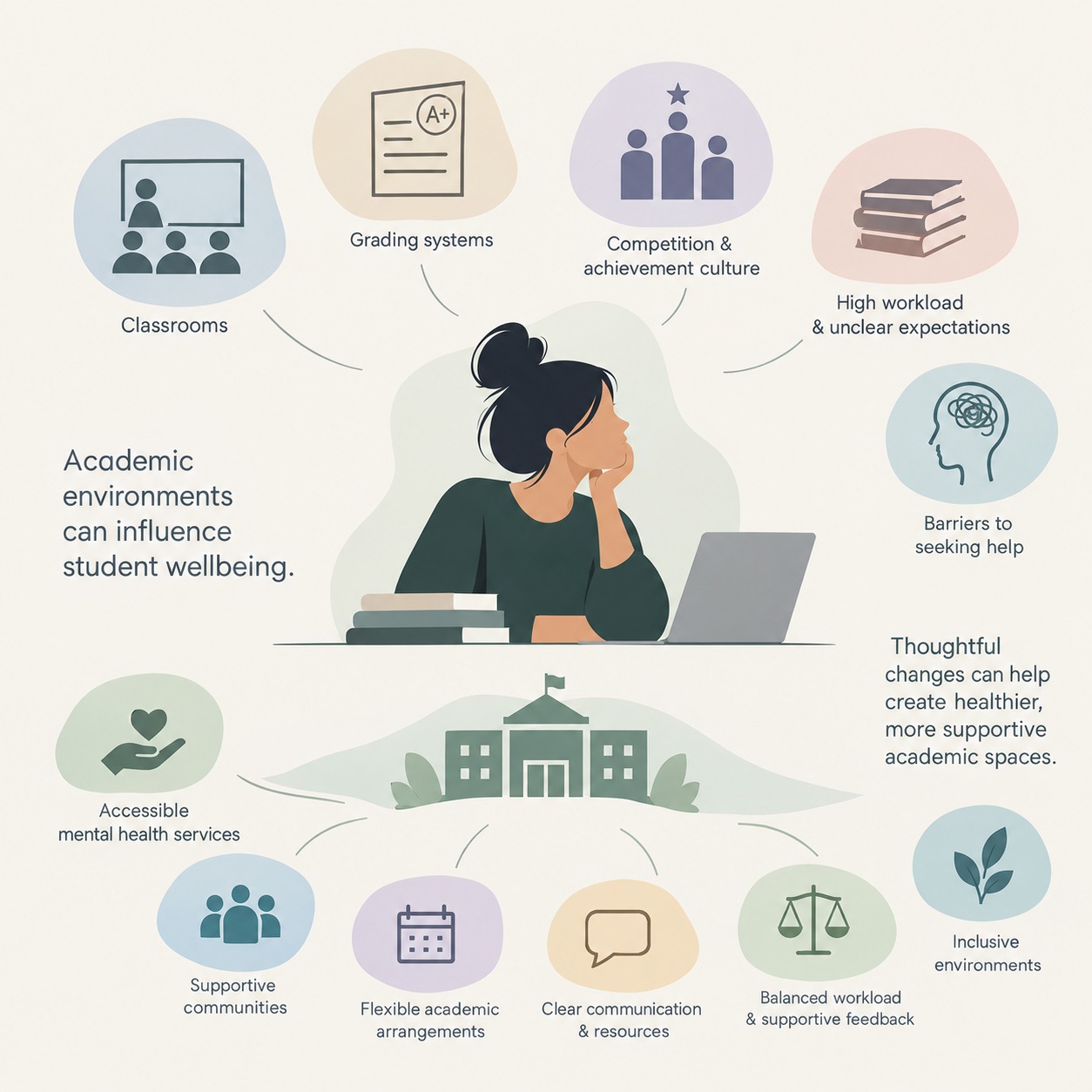
When people talk about student mental health, the conversation often focuses on students’ personal habits, resilience, and coping abilities. What receives less attention is the daily environment students navigate, including classrooms, grading systems, and the broader culture around achievement. These elements are not always neutral; for some students, they may contribute to feelings of pressure or lack of support.
We should not view academic institutions as inherently harmful. Rather, it is better to explore how certain common features of academic environments may influence student wellbeing and why this relationship may benefit from greater consideration.
Stress Does Not Begin at the Exam
Research has highlighted the academic environment as one potential source of student distress. For example, a 2025 study published in Humanities and Social Sciences Communications noted that students pointed to high volumes of educational tasks and unclear assessment methods as factors linked to academic stress. The study also indicated that coping approaches and available institutional support could influence these experiences (Pérez-Jorge et al., 2025). This suggests that aspects of how learning is structured, such as workload, evaluation methods, and clarity of expectations may play a contributing role.
A multilevel analysis published in Frontiers in Education (2024) examined student experiences across OECD countries. Findings indicated that many students reported worries related to test difficulty, grades, and preparation. Such patterns point to the possibility that shared conditions within academic settings may contribute to these experiences, beyond individual factors alone.
The Culture of Competition
Academic settings sometimes emphasize performance ranking and comparison, which can shape how students relate to learning. Research has explored links between competitive elements and experiences of stress or anxiety. Some case studies have described burnout among high-performing students, including feelings of fatigue and reduced engagement. These experiences are not limited to students facing academic difficulties; those who have historically performed well may also encounter pressure when self-worth becomes closely tied to grades.
There is also evidence suggesting connections between high academic pressure and lower self-esteem in certain contexts, even among students achieving strong results. This highlights a nuance that grade-focused discussions may sometimes overlook: strong academic performance does not always safeguard mental wellbeing when performance is framed as a central measure of personal value.
When Asking for Help Becomes Difficult
Recognizing the need for support does not always lead to seeking it. 2024 research on undergraduate students found that a notable portion screened positive for anxiety or depression symptoms at university entry, yet only a smaller share accessed university mental health services during the first year.
Barriers to help-seeking can vary. A systematic review of 45 studies across 23 countries identified categories such as personal concerns, including stigma or reluctance. Structural issues such as financial constraints or service availability, and institutional factors including resource limitations and staff training. These barriers often extend beyond individual willingness and reflect how support systems are organized and communicated.
In some research, students have described challenges such as affordability of treatment or difficulties accessing timely appointments. For many, the primary obstacles relate to access rather than reluctance.
Structure, Support, and What Institutions Can Do
These observations do not imply that academic environments are uniformly challenging or that all students experience pressures in the same way. Individual circumstances, cultural backgrounds, support networks, and personal histories all influence responses to academic demands. What research suggests is that institutional structures and policies may matter. Many approaches currently place primary responsibility on students to seek support, while broader structural factors receive less emphasis.
Institutions are increasingly encouraged to consider student wellbeing through accessible services, flexible academic arrangements, inclusive environments, and clear communication of resources. Approaches such as supportive feedback, balanced workload distribution, and visible support networks may help create conditions where academic challenges do not unduly affect students’ sense of safety and belonging. Strong peer connections, family support, and responsive academic relationships can also play protective roles.
A Broader Conversation
Student wellbeing is shaped by many factors, including financial circumstances, housing, family expectations, and social conditions that extend beyond any single institution. Acknowledging this wider context helps frame discussions about academic environments thoughtfully, neither excusing needed improvements nor viewing institutional changes as a complete solution.
Academic settings may contribute to conditions that reduce unnecessary distress and make support more accessible. This involves considering how institutional design relates to student experiences, as these elements appear more connected than they may initially seem.
References
1. https://pmc.ncbi.nlm.nih.gov/articles/PMC11311661/
2. https://journals.plos.org/plosone/article?id=10.1371/journal.pone.0347553
3. https://rsisinternational.org/journals/ijriss/articles/exploring-the-causes-of-psychological-distress-among-university-students/
4. https://rsisinternational.org/journals/ijriss/view/systematic-review-on-global-trend-in-students-academic-stress-prevalence-causal-factor-and-psychological-implication
5. https://www.sciencedirect.com/science/article/pii/S1472811724000041
6. https://www.nature.com/articles/s41599-025-04698-y
Editorial Note: This article was developed as part of a collaborative editorial group task by Cohort 2 interns at the Discover Psychology Foundation and is featured in the Intern Works Exhibition.