By Mina Faisal
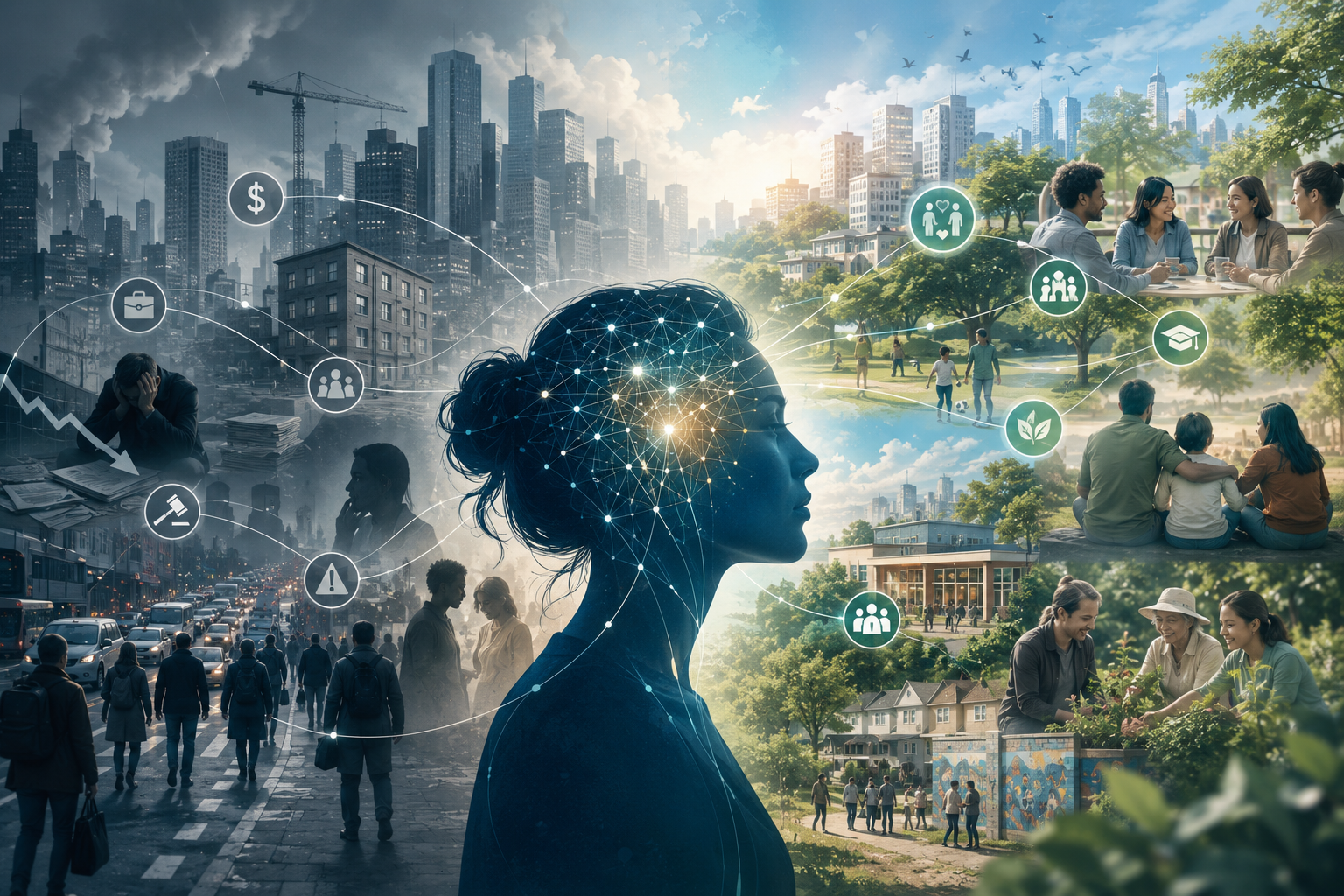
For a long time, we have been told that mental health is a deeply personal, individual issue. We are often taught to look inside ourselves at our brain chemistry, our genetics, or our personal coping skills whenever we feel anxious, down, or overwhelmed. But our minds do not live in a vacuum. Every single day, our mental well-being is shaped by the world around us. The communities we live in, the money in our bank accounts, the jobs we work, and the way society treats us play a massive role in how we feel. In professional spaces, these external forces are called the social determinants of mental health, which is just a formal way of saying the everyday circumstances around us that influence our mental health over time (Alegría et al., 2018). To truly understand mental health, we have to look beyond the individual and explore how society leaves its mark on our minds.
One of the most consistent findings in mental health research is that your place on the social ladder strongly predicts your psychological well-being. This is often called the social gradient, meaning that the lower a person’s income and social standing, the harder life is on their mental health (Alegría et al., 2018). Living with financial strain means dealing with constant, daily worries about rent, groceries, and sudden emergencies. This kind of persistent insecurity keeps the body’s natural stress response, or fight-or-flight system, constantly turned on. Over time, this chronic stress causes physical and mental wear-and-tear, making a person far more vulnerable to anxiety and depression (Wilson, 2025). Furthermore, while researchers once wondered if mental struggles caused poverty or vice versa, poverty is consistently identified as a primary social risk factor strongly associated with poorer mental health (Silva, 2016). The sheer pressure of trying to survive in a difficult financial situation is a primary driver of mental distress. It is not just about personal income, either our immediate surroundings matter. Living in an area with high crime rates, noisy streets, polluted air, and very little green space or park areas acts as a silent, constant stressor that chips away at peace of mind (Kirkbride et al., 2024).
In addition to financial challenges, society distributes its resources and respect unequally. When people are marginalized because of their race, gender, religion, background, or identity, they carry a heavy emotional burden that others do not have to carry. To explain this, researchers use a concept called the Minority Stress Model, originally proposed by Meyer (1995, 2003), which explains that people from marginalized groups face extra, unique layers of stress on top of the normal struggles of daily life. These extra stressors generally fall into direct pressures, like facing discrimination, being treated unfairly at work, and experiencing outright exclusion, as well as internalized pressures (Fink-Samnick, 2021). Internalized pressure is the quiet, mental toll of those experiencing the constant state of high alert and always wondering if you will be judged or rejected next. Over time, people can internalize the negative messages they hear from society, leading to deep feelings of shame, low self-worth, and isolation. When you are constantly forced to protect yourself from a world that feels hostile, your mental battery drains rapidly, leading to much higher rates of chronic anxiety and depression.
At the same time, the rapid pace of the modern world has introduced entirely new ways for society to impact our minds. While technology and modern progress have brought incredible conveniences, they have also created unique psychological traps. Social media keeps us constantly connected, but it also invites non-stop comparison. We scroll through other people’s curated, perfect lives, which can make us feel insecure, left out, and lonely. For younger generations, this digital lifestyle is closely linked to rising sleep issues, body image struggles, and anxiety (Magomedova & Fatima, 2025). This is compounded by hustle culture, which is the societal idea that your worth is tied directly to how productive you are. With smartphones, work emails follow us home, erasing the boundaries between our professional and personal lives. This constant pressure to perform leads to clinical burnout, leaving people feeling emotionally empty and physically exhausted (Magomedova & Fatima, 2025).
If society has the power to cause deep distress, it also holds the ultimate cure in the form of human connection. Having strong social support and community connections acts as a protective shield for our minds. When we have people we can count on, whether it is a family member who listens, a friend who makes us laugh, or a neighbor who lends a hand, it actually changes how our brains perceive trouble. When a crisis hits, knowing we are not alone makes the problem feel manageable, lowering how stressed we feel and protecting us from falling into a deep depression (Acoba, 2024). This shield is incredibly important during our youth, as children and teenagers who feel supported by their families, teachers, and peers are far less likely to struggle with self-harm or broader emotional and social difficulties as they grow up (Harahap, 2024). Sociologists also talk about social capital, which is basically the invisible glue of trust and cooperation that holds a neighborhood together (Kirkbride et al., 2024). Neighborhoods where people know their neighbors, look out for one another, and participate in community events have lower overall rates of mental illness.
Beyond the pressures of our digital and professional lives, the physical environments we live in also play a crucial role in shaping mental health. Rapid urbanization means more people live in crowded cities than ever before. This rapid shift toward densely packed urban living can be surprisingly isolating and leave our nervous systems feeling constantly overstimulated due to a lack of access to natural green spaces.
Because society plays such a massive role in our mental well-being, the way we treat mental health has to change. We cannot simply give someone a coping strategy or a prescription and send them back into the exact same stressful environment that made them sick in the first place. This realization is pushing doctors and therapists toward a concept called structural competency, which is the practice of looking at a person’s entire life story, their housing situation, their job security, and their social struggles before deciding how to help them (Woods-Jaeger et al., 2024). Furthermore, many mental health professionals are embracing the Scientist-Practitioner-Advocate model (Mallinckrodt et al., 2014). This means that being a good mental health professional is not just about sitting in a quiet office doing therapy. It is also about stepping out into the community to advocate for better policies, fairer workplaces, safer neighborhoods, and equal access to care.
Ultimately, mental health is a mirror of the society we build. While individual therapy and self-care are wonderful tools, they are only half the battle. To build a truly healthy world, we have to address the root causes of our collective pain. By building supportive communities, reducing financial inequality, fighting discrimination, and creating space to rest in our fast-paced world, we can foster a society where mental well-being is a natural outcome rather than an uphill battle.
References
Acoba, E. F. (2024). Social support and mental health: the mediating role of perceived stress. Frontiers in Psychology, 15. https://doi.org/10.3389/fpsyg.2024.1330720
Alegría, M., NeMoyer, A., Falgàs Bagué, I., Wang, Y., & Alvarez, K. (2018). Social determinants of mental health: Where we are and where we need to go. Current Psychiatry Reports, 20(11), 95. https://doi.org/10.1007/s11920-018-0969-9
Fink-Samnick, E. (2021). The social determinants of mental health. Professional Case Management, 26(3), 121–137. https://doi.org/10.1097/ncm.0000000000000497
Harahap, A. P. (2024). The effect of social support on adolescent mental health: Literatur review. Journal of Adolescent Mental Health Research, 3(1), 41–52.
Kirkbride, J. B., Anglin, D. M., Colman, I., Dykxhoorn, J., Jones, P. B., Patalay, P., Pitman, A., Soneson, E., Steare, T., Wright, T., & Griffiths, S. L. (2024). The social determinants of mental health and disorder: evidence, prevention and recommendations. World Psychiatry, 23(1), 58–90. https://doi.org/10.1002/wps.21160
Magomedova, A., & Fatima, G. (2025). Mental health and well-being in the modern era: A comprehensive review of challenges and interventions. Cureus, 17(2), e77683. https://doi.org/10.7759/cureus.77683
Meyer, I. H. (1995). Minority stress and mental health in gay men. Journal of Health and Social Behavior, 36(1), 38–56. https://doi.org/10.2307/2137286
Meyer, I. H. (2003). Prejudice, social stress, and mental health in lesbian, gay, and bisexual populations: Conceptual issues and research evidence. Psychological Bulletin, 129(5), 674–697. https://doi.org/10.1037/0033-2909.129.5.674
Silva, M. (2016). Social determinants of mental health: a review of the evidence. Revista de Psiquiatría y Salud Mental, 9(4), 215–224.
Wilson, K. (2025). What do the social determinants of mental health mean for psychiatry, psychology and law? Psychiatry, Psychology and Law, 32(1), 1–18. https://doi.org/10.1080/13218719.2025.2578533