By Dur e Mufasarah
1. Introduction
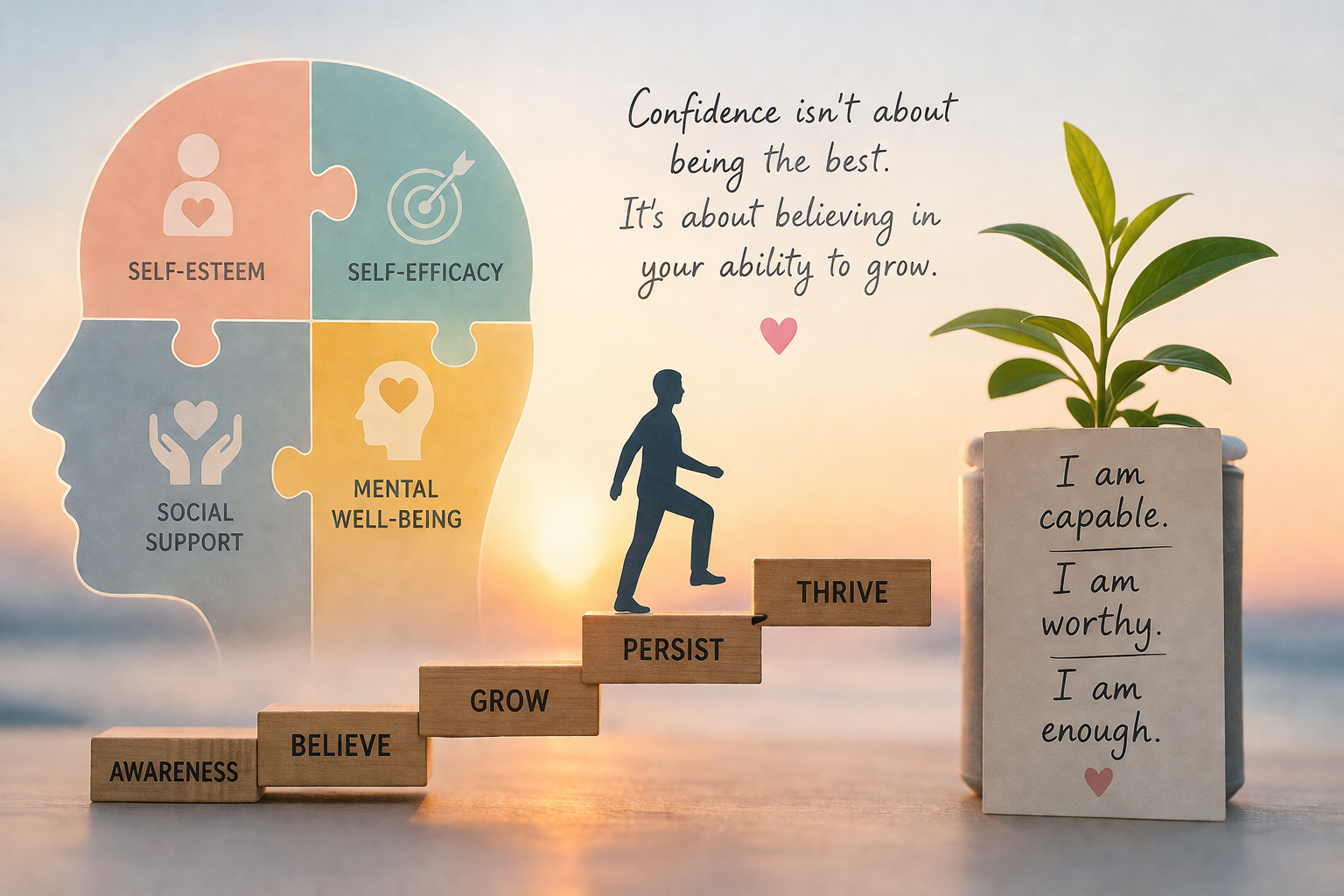
Self-confidence plays an important role in how individuals think, feel, learn, and interact with the world. It is closely related to two important psychological constructs: self-esteem and self-efficacy. Self-esteem refers to how people evaluate their own worth and value (Rosenberg, 1979), while self-efficacy refers to one’s belief in the ability to perform tasks and manage challenges successfully (Bandura, 1977). Together, these concepts shape motivation, emotional well-being, academic engagement, and interpersonal relationships.
Rather than being an inborn trait, self-confidence gradually develops through experience, social interaction, feedback, and opportunities for mastery. When individuals believe they are capable and worthy, they may be more willing to take healthy risks, cope with stress, communicate effectively, and persist through difficulty. In contrast, ongoing self-doubt may be associated with increased vulnerability to anxiety, avoidance, and reduced participation in learning and social contexts.
Maslow’s hierarchy of needs further highlights the importance of confidence by positioning esteem needs, such as respect, competence, and recognition, as described as important for psychological growth and self-actualisation (Selvam & Gomathi, 2022). For adolescents and students, these processes are especially relevant because they are simultaneously navigating identity formation, academic demands, and social belonging.
This article synthesises contemporary research and theory to explore how self-confidence functions as a supportive and protective factor for mental health. By integrating perspectives from self-esteem, self-efficacy, and motivation research, the discussion highlights how confidence supports learning, emotional resilience, and psychological well-being, while also outlining practical, research-based strategies for strengthening it ethically.
2. Theoretical Foundations of Self-Confidence
a) Rosenberg’s Self-Esteem Theory
Rosenberg conceptualized self-esteem as a person’s overall evaluation of their own value. Rather than focusing only on performance, self-esteem reflects whether individuals see themselves as capable, deserving, and accepted. Healthy self-esteem does not imply superiority over others but a balanced sense of self-respect and self-acceptance.
Negative self-beliefs, such as persistent self-criticism or fear of failure, may gradually affect emotional health by increasing sensitivity to stress and reducing motivation to engage in challenges. Research by Selvam & Gomathi (2022) suggests that adolescents with healthier self-esteem often demonstrate greater emotional stability and academic engagement. Importantly, self-esteem develops within social and cultural contexts; supportive environments and respectful feedback can nurture positive self-perception, while harsh comparison or exclusion may undermine it.
Thus, self-esteem provides the emotional foundation upon which confidence in action can be built, supporting both psychological comfort and motivation.
b) Bandura’s Self-Efficacy Theory
While self-esteem focuses on self-worth, Bandura’s theory of self-efficacy emphasizes belief in one’s ability to perform specific tasks. According to Bandura (1977), individuals are more likely to act effectively when they believe their efforts can influence outcomes.
Das (2025) explains that self-efficacy develops from mastery experiences, social modelling, encouragement, and emotional regulation. When people experience success, observe others succeed, and receive constructive feedback, their confidence becomes more realistic and sustainable.
Research consistently links self-efficacy with persistence, problem-solving, and emotional regulation. Instead of avoiding difficulty, individuals with stronger efficacy beliefs are more likely to interpret challenges as manageable. In this way, self-efficacy may not only improve performance but also support mental health by reducing helplessness and increasing coping capacity.
c) Maslow’s Hierarchy of Needs
Maslow’s framework situates confidence within a broader human development process. After basic and social needs are met, individuals seek esteem, which includes competence, recognition, and self-respect. Without this level, growth toward self-actualisation may become more difficult (Selvam & Gomathi, 2022).
Maslow’s model connects confidence to well-being rather than the ego. Feeling capable and valued encourages creativity, purpose, and emotional balance. When esteem needs are neglected, individuals may struggle with insecurity, withdrawal, or fear of evaluation.
Together, Rosenberg, Bandura, and Maslow demonstrate that self-confidence is both emotional and functional: people benefit psychologically when they feel worthy and capable of acting effectively in their environments.
3. Self-Confidence in Learning and Performance Contexts
Self-confidence can influence how individuals participate in learning and performance contexts. Students with healthy confidence are more likely to ask questions, attempt challenging tasks, communicate ideas, and tolerate mistakes as part of learning rather than as personal failure.
(Akbari & Sahibzada, 2020) shows that self-confidence positively influences students’ engagement, classroom interaction, and academic persistence. Similarly, Dewi et al. (2022) and Tripudiyana et al. (2022) link higher self-esteem with improved speaking performance, suggesting that confidence reduces fear of expression and supports communicative competence.
Confidence also interacts with motivation and strategy use. (Hidajat et al., 2023) demonstrates that self-efficacy enhances academic motivation, which then improves learning behaviors. (Bakdoolot & Dangin, 2024) further shows that belief in capability predicts achievement more consistently than raw ability alone.
Beyond education, Lochbaum et al. (2022) confirmed, through a meta-analysis, that confidence is associated with better sport and task performance because individuals regulate stress more effectively and maintain focus under pressure. Setyaningsih et al. (2024) emphasized that the role of social environments, encouragement, modelling, and psychological safety enables individuals to take intellectual and emotional risks.
Overall, confidence may not only reflect success; it often contributes to it by supporting engagement, emotional regulation, and perseverance. Low confidence, by contrast, may encourage avoidance, performance anxiety, and self-limiting behaviour even when ability is present.
4. Self-Confidence and Mental Health
Beyond performance, self-confidence plays a supportive role in mental health. Individuals with stronger confidence often cope more effectively with stress, uncertainty, and social demands.
(Malkoç & Mutlu, 2019) shows that self-confidence works with cognitive flexibility to enhance psychological well-being. When people believe in their ability to adapt, challenges may feel manageable rather than overwhelming. (Syuhada et al., 2021) also demonstrates that confidence strengthens motivation, which supports emotional regulation and persistence during demanding professional training. Confidence does not remove stress, but it changes how stress is experienced and managed.
Further, van Munster et al. (2022) highlight how self-efficacy supports communication and emotional openness in vulnerable populations, enabling individuals to discuss anxiety and distress more confidently rather than withdrawing. (Halilsoy, 2024) similarly emphasizes that confidence contributes to emotional balance, social participation, and resilience.
Rather than eliminating stress, healthy confidence appears to change how stress is interpreted. It encourages agency, reduces helplessness, and supports adaptive coping strategies that protect mental well-being across academic, social, and occupational settings.
5. Enhancing Self-Confidence: Evidence-Based Strategies for Mental Health
Because self-confidence develops through interaction with experiences and social contexts, it is not static and may be strengthened over time. Contemporary research suggests that effective confidence development is most sustainable when it focuses on skills, feedback, supportive environments, and cognitive processes, rather than on short-term motivation alone. These approaches contribute not only to performance but also to psychological comfort, emotional regulation, and resilience.
a) Mastery and Skill Development
Bandura (1977) identifies mastery experiences as one of the most influential sources of self-efficacy. When individuals complete tasks that are challenging yet attainable, they gradually construct realistic beliefs about their capabilities. Similarly, Artino Jr. (2012) explains that learners build confidence when they complete structured, achievable tasks. Rather than producing inflated self-beliefs, repeated mastery supports a sense of competence that may reduce uncertainty and enhance emotional stability, thereby contributing to mental well-being.
b) Goal Setting and Self-Regulation
Confidence is also supported through self-regulatory processes such as goal setting and reflection. Breaking broader objectives into manageable steps can help individuals maintain motivation and minimise feelings of overwhelm. (Benabou & Tirole, 2002) argues that when effort is perceived as meaningful and attainable, confidence and motivation operate in a mutually reinforcing manner. Small achievements may therefore strengthen individuals’ perceptions of control and coping ability, which is closely associated with reduced stress and improved psychological adjustment.
c) Constructive Feedback and Social Support
The social environment plays a central role in the development of confidence. Anithalakshmi (2022) demonstrates that supportive evaluation climates contribute significantly to self-esteem development. Encouragement from teachers, peers, and mentors communicates acceptance and competence, which may foster emotional security. Extending this, Setyaningsih et al. (2024) show that psychologically safe environments allow individuals to participate without excessive fear of judgment. Such contexts not only enhance confidence but may also protect mental health by promoting belonging and emotional openness.
d) Reframing Thoughts for Emotional Balance
Cognitive processes also influence how confidence is experienced. Artino Jr. (2012) notes that reflection and feedback help learners interpret performance constructively. When mistakes are reframed as part of learning rather than as indicators of personal inadequacy, individuals may regulate emotions more effectively. This cognitive reframing can reduce harsh self-criticism and support emotional balance, allowing confidence to function as a stabilising rather than pressurising force.
e) Modelling and Observation
Observational learning provides another pathway for strengthening confidence. Das (2025) explains that observing others succeed in similar situations may enhance beliefs about one’s own potential for success. Such modelling offers realistic examples of coping and achievement, which may normalise challenges and reduce feelings of isolation. In mental health terms, this process supports hope, agency, and perceived social connection.
Importantly, confidence development should remain culturally sensitive. Different communities value modesty, collaboration, and collective success, so confidence should be framed as competence with humility, not self-promotion. Approaches that emphasise respect, inclusion, and emotional safety allow confidence to support well-being without reinforcing unhealthy comparison or pressure.
Through these mechanisms, self-confidence operates as a psychological resource that supports agency, resilience, and emotional comfort, rather than competition or perfectionism.
6. Conclusion
Self-confidence represents an important psychological resource supporting mental health, learning, motivation, and resilience. Integrating Rosenberg’s self-esteem, Bandura’s self-efficacy, and Maslow’s humanistic framework illustrates that confidence involves both feeling worthy and believing in one’s ability to act effectively.
Across educational, social, and performance contexts, research generally suggests that confidence supports participation, persistence, emotional regulation, and adaptive coping. Rather than resembling arrogance, healthy self-confidence reflects balanced self-trust grounded in experience, encouragement, and reflection.
Importantly, confidence is not fixed. It develops through practice, opportunity, feedback, and supportive environments. When individuals are treated with respect and inclusion, confidence becomes a bridge between potential and psychological well-being.
Strengthening self-confidence is therefore not merely an academic goal but a mental health investment, one that empowers individuals to approach challenges, relationships, and life with resilience, purpose, and emotional stability.
References:
Akbari, O., & Sahibzada, J. (2020, January 22). Students’ Self-Confidence and Its Impacts on Their Learning Process. American International Journal of Social Science Research, 5(1), 1-15. https://doi.org/10.46281/aijssr.v5i1.462
Anithalakshmi, S. (2022, December). A Study On The Factors That Influence Self-Esteem. International Journal of Current Science (IJCSPUB), 12(4), 755-761. https://rjpn.org/ijcspub/papers/IJCSP22D1329.pdf
Artino Jr., A. R. (2012, April 11). Academic self-efficacy: from educational theory to instructional practice. Perspectives on medical education, 1(2), 76-85. https://doi.org/10.1007/s40037-012-0012-5
Bakdoolot, A., & Dangin. (2024, August). The Relationship Between Self-Efficacy and Academic Achievement Among Indonesian College Students. International Journal of Social Sciences and Human Resources, 7(8), 6610-6617. https://doi.org/10.47191/ijsshr/v7-i08-95
Bandura, A. (1977). Self-efficacy: Toward a Unifying Theory of Behavioral Change. Psychological Review, 84(2), 191-215. https://educational-innovation.sydney.edu.au/news/pdfs/Bandura%201977.pdf
Benabou, R., & Tirole, J. (2002, August 01). SELF-CONFIDENCE AND PERSONAL MOTIVATION. The Quarterly Journal of Economics, 117(3), 871-915. https://doi.org/10.1162/003355302760193913
Das, K. (2025, September). ALBERT BANDURA’S SELF-EFFICACY THEORY AND ITS IMPLICATIONS IN HUMAN LIFE. ResearchGate, 179-185. 10.25215/9358792922
Dewi, I. A., Erlik Widiyani, E., & Kurniawan, A. (2022, June 17). The Relationship between Students’ Speaking Skill and Students’ Self-Esteem of Mover F Class of NCL Madiun. Journal of English Teaching, 8(2), 267-281. https://doi.org/10.33541/jet.v8i2.3743
Halilsoy, T. (2024, November 29). The Importance of Self-Confidence. Academic Journal of History and Idea, 11(5), 2975 – 2989. https://doi.org/10.46868/atdd.2024.803
Hidajat, H. G., Hanurawan, F., Chusniyah, T., Rahmawati, H., & Gani, S. A. (2023, October 19). The Role of Self-Efficacy in Improving Student Academic Motivation. KnE Social Sciences, 8(19), 175–187. https://doi.org/10.18502/kss.v8i19.14362
Lochbaum, M., Sherburn, M., Sisneros, C., Cooper, S., Lane, A. M., & Terry, P. C. (2022, May 24). Revisiting the Self-Confidence and Sport Performance Relationship: A Systematic Review with Meta-Analysis. International Journal of Environmental Research and Public Health, 19(11). https://doi.org/10.3390/ijerph19116381
Malkoç, A., & Mutlu, A. K. (2019, November 18). Mediating the Effect of Cognitive Flexibility in the Relationship between Psychological Well-Being and Self-Confidence: A Study on Turkish University Students. International Journal of Higher Education, 8(6), 278-287. https://doi.org/10.5430/ijhe.v8n6p278
Rosenberg, M. (1979). Conceiving The Self (reprint ed.). Basic Books.
SELVAM, D. P. M., & GOMATHI, D. A. (2022, July-December). AN ANALYSIS OF MASLOW HIERARCHY APPROACHES AND IMPACT OF SELF ESTEEM AMONG ADOLESCENTS. RESEARCH EXPLORER-A Blind Review & Refereed Quarterly International Journal, 10(36), 2349-1647. https://www.researchgate.net/publication/375238845_AN_ANALYSIS_OF_MASLOW_HIERARCHY_APPROACHES_AND_IMPACT_OF_SELF_ESTEEM_AMONG_ADOLESCENTS
Setyaningsih, E., Yani, M. N., & Prasetyo, N. C. (2024). DETERMINING FACTORS OF SELF-CONFIDENCE IN A USING SOCIAL ENVIRONMENT PATH ANALYSIS. European Journal of Education Studies, 11(5). http://dx.doi.org/10.46827/ejes.v11i5.5326
Syuhada, I., Duarsa, A. B. S., & Anulus, A. (2021, October 1). Relationship Between Self-confidence and Motivation: The Use of MMPI-2 in Medical Student. Atlantis Press, 567. 10.2991/assehr.k.210930.019
Tripudiyana, T., Sartika, D., & Nery, R. (2022, April). A Correlation between Students’ Self-Esteem and Speaking Skill. Journal of English Language Teaching and Learning (JETLE), 3(2), 49-57. https://doi.org/10.18860/jetle.v3i2.15610
van Munster, E. P. J., van der Aa, H. P. A., Verstraten, P., Heymans, M. W., & van Nispen, R. M. A. (2022, April 21). Improved intention, self-efficacy and social influence in the workspace may help low vision service workers to discuss depression and anxiety with visually impaired and blind adults. BMC Health Services Research, 22. https://doi.org/10.1186/s12913-022-07944-0
Editorial Note: This article was developed by a Cohort 1 intern at the Discover Psychology Foundation and is featured in the Editorial Internship Exhibition.