By Mina Faisal
The landscape of child development has undergone a profound paradigm shift in recent years. While the 20th century was largely dominated by the pursuit of cognitive milestones and the Intelligence Quotient (IQ) as the ultimate measure of potential, the 21st century recognizes a more nuanced truth. A child’s ability to navigate the social and emotional world, their emotional intelligence, is increasingly viewed as an important contributor to long-term success, mental health, and systemic resilience. In nations like Pakistan, where education systems have traditionally emphasized rote memorization and high-stakes academic performance, the growing recognition of emotional literacy reflects an emerging shift in priorities (Tiwana, 2025).
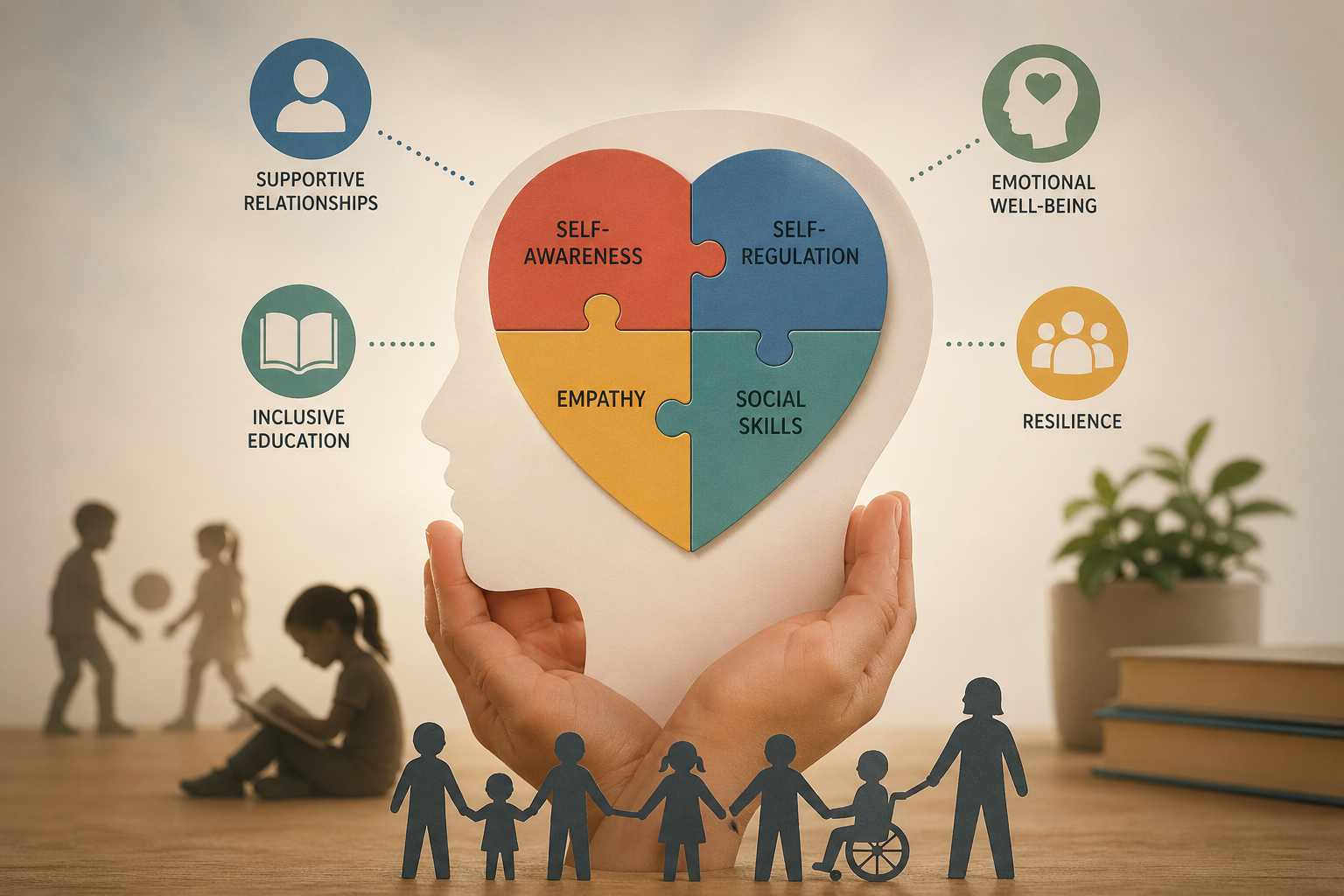
Emotional intelligence is often described as a set of interrelated competencies, including self-awareness, self-regulation, empathy, and social skills. To foster these in the next generation, we must examine the intersection of attachment, parenting, inclusivity, and the economic necessity of social-emotional growth.
The development of emotional intelligence begins in the cradle and is deeply rooted in attachment theory. This theory suggests that early bonds between infants and caregivers play a foundational role in shaping expectations and patterns in later relationships (Bowlby, 1969; 1982).
Recent research suggests that the quality of this bond is strongly influenced by maternal emotional availability, not just physical presence. Rolo and colleagues (2024) highlight that emotional availability in middle childhood remains an important factor in a child’s ability to regulate their own emotions. When a parent is emotionally accessible, the child learns to mirror that stability. This may be particularly relevant for vulnerable groups, such as orphaned adolescents, who may experience disruptions in consistent caregiving, which can provide this emotional mirroring (Khan & Kamal, 2023). Without this foundation, children may struggle with emotion control, which has been associated with an increased risk of long-term loneliness (Nightingale et al., 2024).
As children move from the home into the wider world, they face various pivotal stages where they must balance their own needs with social expectations. From developing basic trust to finding a sense of competence in school, each stage requires emotional maturity to resolve (Erikson, 1950). Challenges in navigating these stages may be associated with emotional distress or behavioral difficulties (Sneed et al., 2012).
Furthermore, the long-term effects of early parental conduct are now being linked directly to identity development in late adolescence (Shahlal et al., 2023). While the home remains the first classroom for emotional education, research suggests that parenting styles play a significant role in the architecture of this landscape. Authoritative parenting, characterized by warmth and clear boundaries, is often associated with positive social and emotional outcomes (Sirait & Slameto, 2024). These parents validate feelings while guiding behavior, an approach linked to higher social skills (Muntaha et al., 2024). In contrast, more controlling parenting approaches may, in some cases, limit opportunities for independent social understanding. Some studies have linked these patterns to increased social anxiety, though outcomes vary depending on context and individual differences. These children may become experts at following rules but struggle to understand the “why” behind social interactions (Sanchez, 2025; Dialnet, 2025).
Emotional intelligence may also play a role in promoting more inclusive educational outcomes. For students with disabilities, meeting emotional and social needs has been shown to significantly improve academic performance (Al-Shaer et al., 2024). By teaching emotional regulation, we provide all students with the internal resources to navigate an often unaccommodating world. These skills can be particularly important for refugee and conflict-affected children, who may rely on emotional regulation and social connection to navigate challenging experiences (UNHCR, 2024).
There is also a significant economic and global case for this shift. Critics sometimes view emotional intelligence as a luxury, but some evidence suggests that social-emotional learning programs are associated with positive long-term educational and economic outcomes (Jacobs Foundation, 2023). When children learn to manage their emotions, they are more likely to stay in school and find stable employment. Global surveys show that students with higher social and emotional skills, such as curiosity and persistence, not only perform better academically but also report higher levels of life satisfaction (OECD, 2023).
To implement these theories in real-world settings like Pakistani schools, we can look toward models like Social, Emotional, and Ethical Learning. Students who engage in this type of learning show marked improvements in resilience by learning to understand their nervous systems and practice compassion (Min et al., 2024).
Throughout these interventions, practitioners must be guided by strict ethical codes, ensuring that any psychological support is culturally sensitive and prioritizes the child’s welfare (APA, 2024). By shifting our focus from pure Intelligence quotient (IQ) to a more balanced approach, we protect our children from loneliness, foster stable identities, and ensure economic prosperity. It is time to treat emotional literacy with the same weight as mathematical literacy to raise a generation truly prepared for the complexities of the modern world
References
Al-Shaer, A., et al. (2024). Impact of Quality of Life on Academic Success of Students with Disabilities. NIH PMC.
American Psychological Association. (2024). Ethical Principles of Psychologists and Code of Conduct.
Bowlby, J. (1969 & 1982). Attachment and Loss. Basic Books.
Dialnet. (2025). Parenting Styles and Social Anxiety in Early Adolescence.
Erikson, E. H. (1950). Childhood and Society. Norton.
Jacobs Foundation. (2023). The Economic Return on Social-Emotional Learning Programs. Evidence Brief 2024-02.
Khan, A., & Kamal, A. (2023). Attachment Styles and Psychological Adjustment in Orphaned Adolescents. Journal of Applied Psychology.
Min, H. J., et al. (2024). Building Resilience through SEE Learning in Elementary Students. Behavioral Sciences.
Muntaha, et al. (2024). The Correlation between Authoritative Parenting and Identity Achievement. Educational Research Review.
Najmussaqib, M., & Mushtaq, M. (2023). Social-Emotional Competence and Behavioral Problems in School Children. Pakistan Journal of Social Sciences.
Nightingale, et al. (2024). Deficiencies in Emotion Control as Predictors of Long-Term Loneliness. World Journal of Biology Pharmacy and Health Sciences.
OECD. (2023). Survey on Social and Emotional Skills (SSES) – Second Round Results.
Rolo, et al. (2024). Mother–Child Attachment and Maternal Emotional Availability in Middle Childhood. PMC – NIH.
Sánchez, P. (2025). The Impact of Parental Educational Styles on Social Skills in Early Childhood.
Shahlal, et al. (2023). Long-term effects of early parental conduct on identity development. ResearchGate.
Sirait, A., & Slameto. (2024). The Influence of Parenting Styles on Student’s Emotional Intelligence. South East European Journal of Public Health.
Sneed, J. R., et al. (2012). The Trajectory of Psychosocial Development in Adulthood. Developmental Psychology.
Tiwana, S. (2025). The Shift from IQ to EQ in Contemporary Pakistani Education. Asian Journal of Pedagogy.
UNHCR. (2024). Social and Emotional Learning (SEL) for Refugee and Conflict-Affected Children.
Editorial Note: This article was developed by a Cohort 1 intern at the Discover Psychology Foundation and is featured in the Editorial Internship Exhibition.