Why Mental Well-Being Matters for Academic Success
By Editorial Interns Cohort 1
(S. Clarke, Mina Faisal, Simrah Asif)
We have all seen the perfect student, the one who stays late in the library, carries a heavy course load, and maintains a flawless GPA. But behind the fluorescent lights and caffeine-fueled study sessions, a quieter struggle often exists. For many students, the classroom, once a place of curiosity, can begin to feel like a high-pressure environment where personal worth becomes closely tied to educational performance.
It is not only about the workload, it can also be about the expectation of perfection. According to a study by the Pew Research Center, researchers Kim Parker and Kiley Hurst found that roughly 70% of teenagers identify anxiety and depression as major problems among their peers (Parker & Hurst, 2019). This points toward broader pressures that may shape how young people experience academic life.
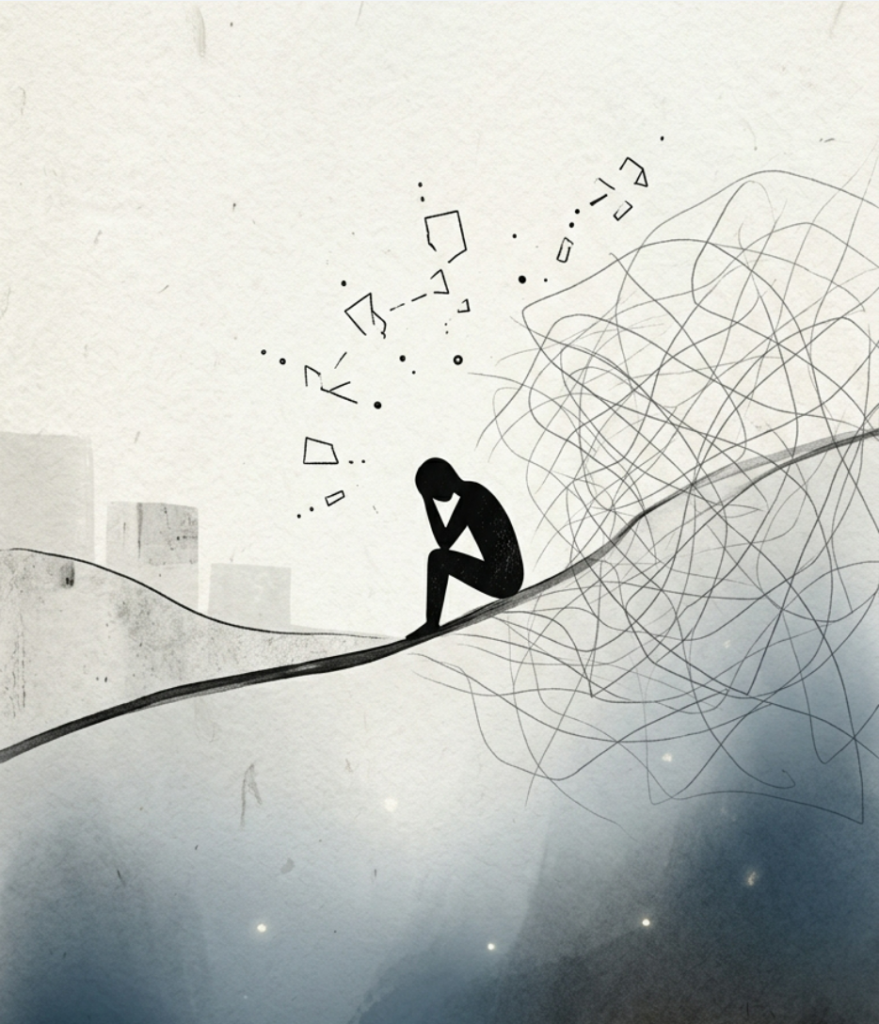
Imagine a student named Sarah. She is not failing, in fact she is excelling. But she describes her life as a tightrope walk, where one bad grade can feel like a total collapse of her future, even if that may not be reality. When we tell students to “just push through”, we may overlook underlying mental and emotional struggles. Over time, this can affect students’ well-being, especially during periods of significant personal and academic development.
While the numbers are concerning, the path forward can include small, intentional changes. Research from the American Psychological Association (APA) indicates that students who report high levels of school belonging, feeling seen and supported by their community, also report lower rates of emotional distress and higher academic persistence (American Psychological Association [APA], 2020). This may suggest that emotional safety is not a distraction from learning; it can support it.
Research suggests that when educational environments prioritize mastery goals, learning for the sake of growth, over performance goals like ranking and competition, student burnout rates may decrease. As noted by Pulfrey et al. (2011), the pressure of constant grading can affect the motivation required for deep learning. Healthy academic cultures are shaped not just by standards, but by the support systems around them.
To bridge this gap, it is important to move beyond the idea that student stress is a rite of passage. The National Alliance on Mental Illness (NAMI) suggests that early intervention and open dialogue in schools can help reduce the longer-term impact of mental health challenges by providing a safety net before a crisis occurs (National Alliance on Mental Illness [NAMI], 2023).
Educators should ideally be equipped to recognize quieter signs of struggle such as withdrawal, the student who stops participating or seems perpetually exhausted rather than just disciplining for late assignments. Mental health should not be an extra topic, it belongs in the curriculum.
Teaching stress management and emotional regulation is not always simple, but it may be just as important as teaching algebra or history. There can be real value in hearing a classmate say they are struggling too. Peer support groups can help reduce the sense of isolation many students experience.
Restoring balance is not a one-time workshop or a poster on a wall. It is a daily commitment to seeing the human being behind the student ID number. It is about creating a culture where a student feels safe saying they are not okay and hearing the response: “Thank you for telling me, let us figure this out together.”
We are more than our transcripts. By prioritizing the person alongside performance, we do not just support better students, we support the development of individuals who understand that their value extends beyond grades.
References:
Mental Health in Schools. (2021, 8 4). NAMI. Retrieved April 17, 2026, from https://www.nami.org/advocacy-at-nami/policy-positions/improving-health/mental-health-in-schools/
Parker, K., & Hurst, K. (2025, March 13). The Gender Gap in Teen Experiences. Pew Research Center. Retrieved April 17, 2026, from https://www.pewresearch.org/social-trends/2025/03/13/the-gender-gap-in-teen-experiences/
Parr, N. J. (2020, 7 1). Differences in the age-varying association of school belonging with socioemotional flourishing among minority and non-minority college and university students. American Psychological Association. https://www.apa.org/education-career/k12/infusing-diversity/mental-physical-health/research-summary-school-belonging
Pulfrey, C., & al, e. .. (2011). Why grades engender performance-avoidance goals: The mediating role of autonomous motivation. American Psychological Association. https://psycnet.apa.org/record/2011-12258-001
Editorial Note: This article was developed as part of a collaborative editorial group task by Cohort 1 interns at the Discover Psychology Foundation and is featured in the Editorial Internship Exhibition.